
Pilates:-
As you age, low-impact exercises like pilates may help with bone health, strength, and mobility. Additionally, it can enhance your mood, memory, and posture A low-impact workout that emphasizes flexibility, core strength, and mindful movement this is pilates.
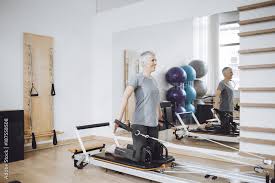
Pilates’ advantages for senior citizens
At many phases of life, Pilates can be extremely beneficial.
1. Increasing the density of bone
Osteopenia and osteoporosis can be prevented by maintaining bone density as you age. Slowing bone degradation requires weight-bearing exercise to increase bone density. reliable source.
A review of research conducted in 2021 According to a reliable source, bone mineral density does not deteriorate during the postmenopausal years, when it normally does.
Try Pilates on the machine if you want to preserve bone density.
Exercises on the Reformer and Tower (or Cadillac) use spring resistance as “weights,” in contrast to Pilates mat work. Compared to mat training alone, this kind of weight-bearing Pilates is probably more effective at increasing bone density.
2. Developing better posture
Slouching and misalignment may be exacerbated by a decrease in bone density. Slouching can result in tight and unbalanced muscles, which frequently cause pain, and it also leads to the compression of your joints and organs as you age.
Pilates emphasizes creating ease and mobility in your joints while balancing and aligning your body.
Better posture is frequently the consequence of having muscles that are both strong and flexible as well as a greater sense of alignment.
3. Improving gait and balance
For daily tasks, balance and coordination are essential. As people age, they frequently notice changes in their gait.
Through targeted balance training and strengthening of the trunk, hips, feet, and ankles, Pilates may help with balance and gait.
A quality Pilates program will increase your strength, stability, and balance, lowering your risk of fractures and falls. Additionally, it will assist you in forming better habits, such learning how to pick up and carry objects or transition between sitting and standing.
4. Increasing mobility
A full, controlled range of motion is made possible by mobility, which is the harmony of strength and flexibility.
If you solely do strengthening exercises, you may become tense, rigid, and more likely to be hurt. An aging body can become weak, unsupported, and prone to injury if flexibility is the primary focus.
According to a 2022 study, six weeks of Pilates may be the best length of time for older persons to increase their functional and overall mobility. Increased mobility reduces the danger of falls and facilitates movement in daily tasks.
5. Raising spirits
The conscious practice of Pilates is founded on the idea that movement should be accompanied by breath. Breathing and introspection help you become more self-aware and relax your nervous system.
According to a 2018 review, Pilates may enhance mental health, especially by lowering despair and anxiety.
One research review from 2022 More than the other types of exercise in the analysis, Pilates may provide psychosocial benefits for older persons when done in a group setting, according to Trusted Source.
6. Enhancing mental abilities
According to the findings of a small 2022 study, consistent Pilates practice may enhance memory and other aspects of cognitive function, or thinking capacity.
In this study, 47 women who had not had their periods for at least a year were examined to see if a Pilates program influenced their cognitive functioning performance. Both immediate memory and evocation (or “calling forth”) memory improved in the group of women who attended twice-weekly Pilates classes for 12 weeks.
7. Reduction of back pain
Pilates focuses on your core, a flexible brace that supports, elevates, and houses your spine and organs. Your back is better supported by a strong core.
According to a 2019 study, after just three months of Pilates practice, several participants noticed improvements in their chronic lower back discomfort.
8. Strengthening immunity
Pilates may help boost immunity, according to some study, especially among older persons.
After 12 weeks of Pilates, a 2020 research of males over 65 revealed notable increases in immune system function.
9. Assisting in the prevention of harm
Pilates gets your body ready for daily tasks that call for strength and flexibility. It places a lot of emphasis on joint stability and support. Additionally, you might be less prone to injury as you develop the ability to move with those concepts in mind.
Your proprioception may also improve as a result of self-awareness and a stronger bond with your body, making you more conscious of your movements in space.
Things to think about when performing Pilates as an older adult
Before beginning any workout program, speak with your doctor. If at all possible, begin with one-on-one sessions. Confidently learning the basics and making adjustments can be facilitated by individualized lessons with a certified Pilates instructor.
On the other hand, many Pilates classes taught by qualified teachers are designed for active senior citizens. There are many variations of Pilates that are both safe and beneficial for bone growth.
For those who have osteoporosis or low bone density, many classic Pilates exercises are not advised. If your bone density is low, you should stay away from:
- Extreme flexion and twisting (imagine a normal crunch)
- Loaded flexion, such rolling on your back in a curved position
Try to stay away from these particular Pilates routines if bone density is an issue for you:
- Rolling Over Like a Ball with a Jackknife
Leave a Reply