
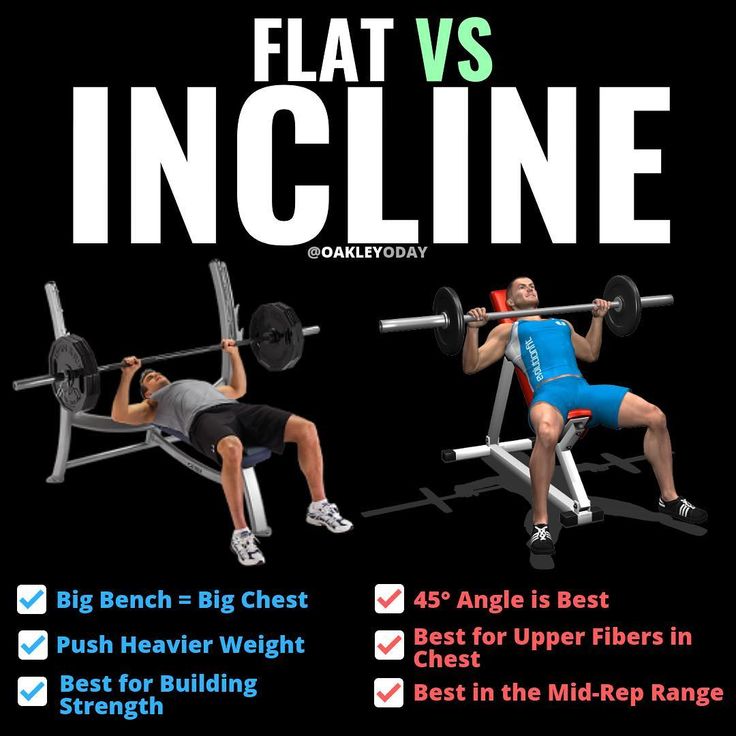
Incline vs. Flat Bench:-
Theoretically, it is a more effective movement. In addition to having more range of motion, the incline bench trains more muscles, including the deltoid, mid, and lower pecs. is a safer exercise as well; simply roll the bar to your hip if you don’t succeed. It’s also safer for the shoulders, according to some this is called Incline vs. Flat Bench.

Although they do so in slightly different ways, both incline and flat bench chest presses can aid in the development of chest muscles. Think about combining both kinds into your regimen for optimal outcomes.
Strong chest muscles are necessary for daily tasks including throwing a ball, pulling a grocery cart, and swimming.
As with any other muscle group, it’s crucial to train your chest muscles. The chest press is one of the most popular and efficient workouts for strengthening your chest muscles. However, is the flat bench chest press or the incline chest press the more efficient?
Actually, there is no right or incorrect response. It mostly depends on your preferences, your own objectives, and what you’re attempting to accomplish. Do both kinds of chest presses to get the best results because they target nearly the same muscles in slightly different ways.
Let’s examine each of these choices.
Both flat bench chest pushes and incline bench presses target a variety of chest muscles, as the table below demonstrates.
Bench presses with an incline
The clavicular and sternocostal heads (upper and lower pec) make up the pectoralis major muscle.
The incline press is designed to concentrate more of the work on the upper pecs. Developing the upper part of the pectoral muscles is the primary advantage of incline presses.
Because it’s similar to a shoulder press, you use your shoulders more when the bench is angled between 15 and 30 degrees. Additionally, due of the bench’s angle, this exercise lessens the strain on your rotator cuff, which is frequently injured when utilizing a flat bench.
However, using an incline chest press has several drawbacks. The flat bench tends to create mass over the entire pec, while the incline chest press puts greater strain on the upper pec, which helps you develop this muscle area.
You should avoid working on your deltoids the next day because you are also actively using your deltoids (shoulders) at this angle. If you train the same muscle group twice in a succession, you risk overtraining your muscles. Any muscle that is overused can get injured.
Step-by-step incline chest press
- On an inclined bench, recline. Ensure that the bench is angled between 15 and 30 degrees. The anterior deltoids (shoulders) are primarily worked by any angle greater than thirty degrees. Your elbows should form a 90-degree angle when you grasp.
- With your palms facing away from you, encircle the bar with your fingers in a shoulder-width grasp. With your arms locked, raise the bar off the rack and hold it straight over you.
- Breathe in, then slowly descend until the bar is only an inch from your chest. The bar should always be parallel to your upper chest. Tuck your arms into your sides at a 45-degree angle.
- tucked into your sides at a 45-degree angle.
- At the bottom of the exercise, hold this position for one count. Then, lift the bar back up to your starting position with a large exhale. Hold, lock your arms, and slowly descend.
- After completing 12 reps, return the bar to the rack.
- Perform five sets in total, increasing the weight after each set.
Bench presses that are flat
As previously stated, the upper and lower pecs make up the pectoralis major. Flat benching is the finest workout for general pec growth since it equally stresses both heads.
Compared to your daily activities, the flat bench press is a far more fluid and natural movement. However, there are certain drawbacks, just like with the incline chest press.
Professional bodybuilder Dorian Yates stated: “I don’t even include flat benching in my pec routine because I think it stresses the front deltoids far too much to be an effective exercise for building the chest.” Additionally, the flat bench press’s angle puts the pec tendons at risk. The majority of overuse problems and shoulder ailments are caused by flat benching. Heavy flat bench presses have caused a lot of torn pecs in bodybuilders.
In my experience as a personal trainer, shoulder injuries are the most prevalent among men. Typical errors include:
- lacking someone to correctly identify them
- They were most likely at a tilt because they were unable to rerack the bar and had an unequal grip with a more dominant side bearing the majority of the weight.
As with any type of press, you must properly warm up your shoulders and chest by stretching and using resistance bands. To lower the risk of injury when flat benching, you must have complete shoulder mobility and scapular stability.
You should definitely think about using dumbbells or the incline bench workout if the flat bench exercise causes you any trouble.
In the end, it comes down to your preference and your objectives. Your pecs are best developed with the flat bench press.
The incline press is safer for your shoulders, rotator cuffs, and pecs, according to several trainers. The chest press with any bench will be beneficial because there are numerous exercises to enhance your chest.
To ensure you’re doing each exercise correctly, follow these guidelines.
Leave a Reply