
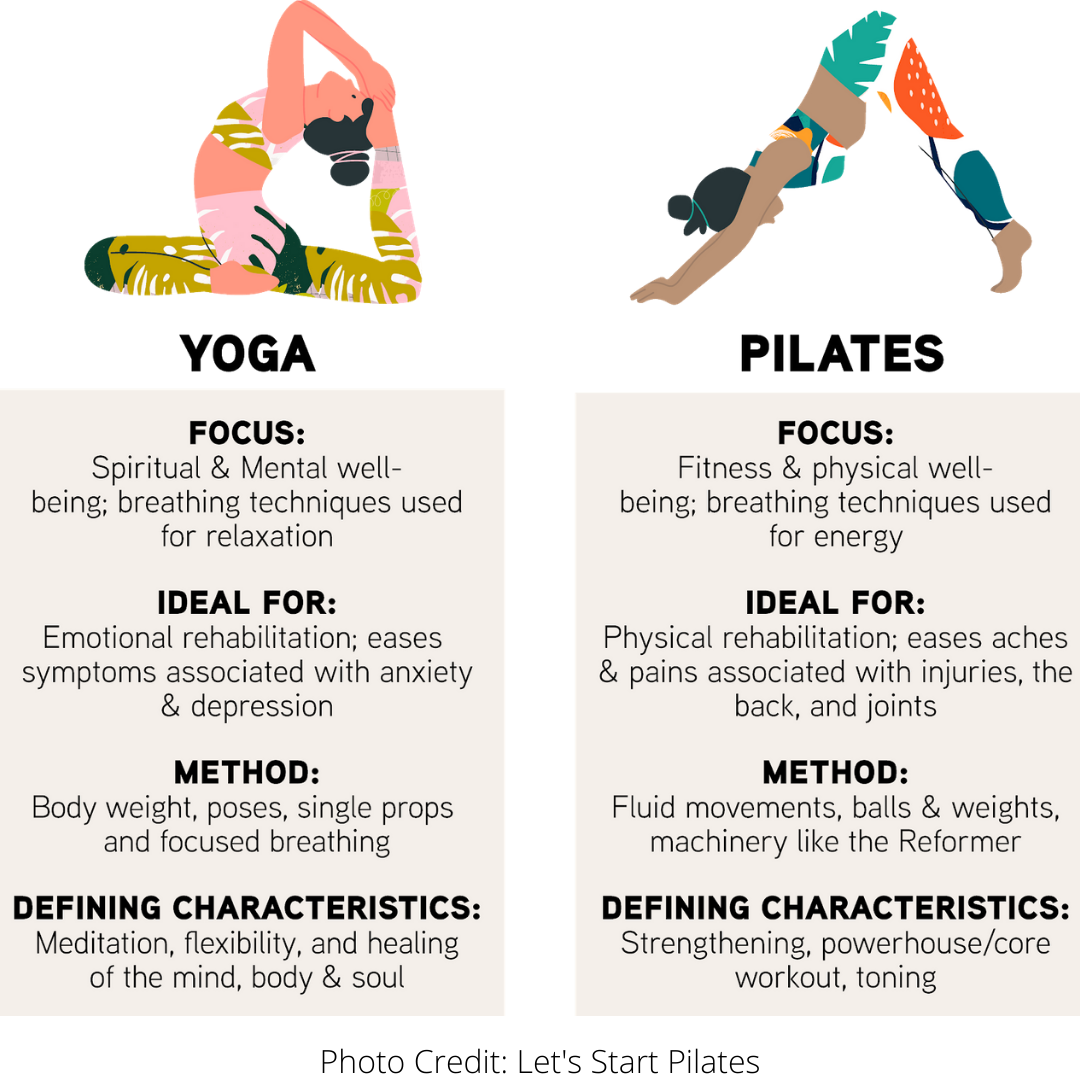
Pilates vs Yoga
Generally speaking, yoga is slower than Pilates and emphasizes awareness and deep breathing throughout the session. Although there are several forms of yoga, most classes follow a common practice that consists of holding various postures and moving through a variety of exercises this is pilates vs yoga.
Yoga
Focuses on mental & spiritual wellbeing, by using breach for relaxation. Yoga is good for emotional rehabilitation in the treatment of mental conditions this is yoga.
Pilates
Focuses on fitness & physical wellbeing, by using breath for energy. Pilates is great for physical rehabilitation in treatment of injuries this is pilates.
Two low-impact exercise forms that employ your body weight as resistance are yoga and pilates. Both have advantages. To assist you decide which could help you achieve your fitness objectives, here is a comparison.
Pilates, yoga, piyo, and yogilates. How do you decide when they all appear to provide comparable workouts? In recent years, yoga and pilates have seen tremendous change. There is something for practically everyone, with several varieties offered at gyms and studios worldwide.
Low-impact exercises that emphasize bodyweight resistance include yoga and pilates. The advantages are numerous. Both types of exercise can improve general health and quality of life.
As with any workout, form is everything. People with physical impairments need special accommodations.
Pilates
Joseph Pilates created Pilates toward the close of World War I. Its main purpose was to help injured soldiers recover. After years of honing his technique, Pilates took his method to the US in 1923.
Pilates could:
- boost your endurance and muscle strength.
- greater posture and flexibility contribute to greater balance, which reduces joint pain.
Pilates emphasizes little movements that call for the activation of crucial core and back stabilizing muscles. Every exercise places a lot of focus on beginning with a deliberate breath that causes the core muscles to contract. Pilates can be performed on specialized apparatus or on a mat. The apparatus is special since it provides resistance solely through the use of springs, levers, and your own body weight.
The following conditions may benefit from Pilates, according to evidence:
- respiratory disorders, urinary incontinence, and arthritis
- back pain and joint injuries
Yoga
The ancient Hindu texts known as the Vedas are where yoga originally appeared, more than 5,000 years ago in India. It is based on the following five beliefs:
- appropriate relaxation
- breathing exercises, diet, meditation, and positive thoughts
Two essential components of a yoga practice are deep breathing and mindfulness. Despite the wide variety of yoga styles, most sessions follow a common pattern of holding different postures and moving through different sequences of movements. One could consider yoga to be a type of mind-body fitness. It blends thoughtful concentration with physical exercise. This raises awareness of the energy and breath.
Numerous studies have been conducted on the advantages of yoga. Yoga is proven to provide advantages for mental and physical health as well as for medical conditions like:
- Depression and anxiety
- respiratory disorders, arthritis, and multiple sclerosis
- Type 2 diabetes, persistent discomfort, and elevated blood pressure
Yoga vs. Pilates: Which is better?
Pilates and yoga are both excellent forms of exercise. To find out what’s best for you, you might want to speak with an instructor if you have a medical problem.
Many yoga poses call for a great deal of joint mobility and flexibility, particularly in the wrists, hips, and spine. A person with severe limits or pain may find it difficult to follow along in more advanced classes, even though most positions may be adapted.
Yoga comes in a variety of forms, such as chair yoga, acro yoga, and restorative yoga. The secret is to figure out what works best for your body.
Because of its gentle motions and low impact exercises, Pilates can be an excellent form of exercise for elderly persons or those recuperating from an accident. Pilates comes in a variety of formats. The kind of equipment used is the primary distinction between them.
Many of the moves used in a mat class are also used in equipment-based workouts, but with more resistance. Many people find mat Pilates to be very beneficial, but those with inadequate core strength or limited mobility may find it more difficult.
Some types of Pilates require access to equipment, and the practice can be costly. Similar to yoga, Pilates can be altered, but in order to prevent damage, the exercises must be taught and performed correctly.
Warnings
If you have respiratory issues or neck or back pain, adjust your exercise regimen. If you have physical limitations or are pregnant, consult your doctor before beginning Pilates or yoga.
A trained instructor and your doctor should always be consulted before beginning an exercise program. Before enrolling in a class or watching a workout video, you might want to consider taking private instruction. Injury might result from improper form or from overexerting oneself.
Next steps
Pilates and yoga are both excellent supplements to your usual workout regimen. These exercises will assist you in achieving your objectives if you want to:
- develop long, slender muscles
- Become more adaptable
- regain mental clarity
- increase the stability of your core
Yoga can help you become more flexible, balance better, and meditate more deeply. Pilates might be more effective for enhancing posture, core strength, and injury recovery.
Leave a Reply